
Light Requirements
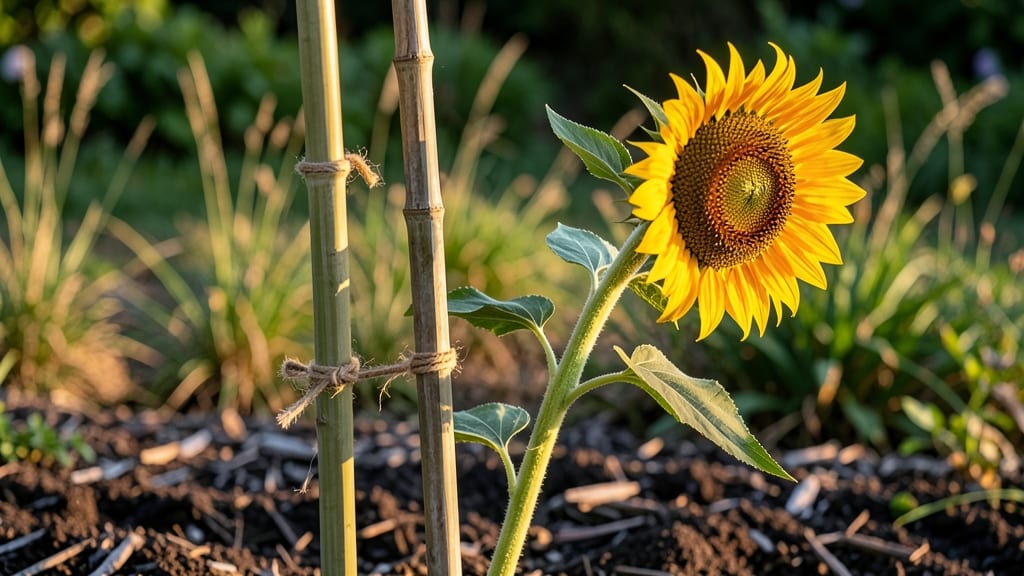
Do sunflowers need to be staked to stand tall and proud in your garden 🌻 — especially when those towering stems reach 8 feet or more.
Picture this: a perfectly sunny afternoon, your sunflowers swaying in the breeze, then suddenly plopping over like a felled giant. That’s the moment you’ll wish you’d staked them sooner.
But here’s the catch: not every sunflower variety needs support, and the wrong approach can actually do more harm than good.
Whether you’re growing dwarf varieties that barely reach your waist or giant sunflowers that could outshine your fence, the right staking strategy depends on your climate, soil, and how much you’re willing to fuss.
Below, I’ll break down when to stake, how to do it without damaging those delicate stems, and which sunflowers can stand on their own—no props required.
You’ll also discover 3 easy DIY staking methods that cost next to nothing, plus the one trick that keeps your sunflowers upright even in a howling windstorm. Let’s get those blooms standing tall!
When and why sunflowers need staking for wind resistance
Sunflowers are nature’s skyscrapers, reaching heights of 6 to 12 feet in a single season. Their towering stems and heavy flower heads make them prime candidates for toppling—especially in windy climates.
But not all sunflowers need staking, and the decision depends on variety, soil, and weather conditions. Let’s break down when staking becomes a necessity and how it protects your plants.
First, consider the sunflower variety. Standard varieties like 'Mammoth' or 'Russian Giant' grow 8 to 12 feet tall and often need support, while dwarf varieties like 'Teddy Bear' or 'Sunspot' stay under 3 feet and rarely topple.
Even medium-height varieties (3–6 feet) may benefit from staking in exposed locations or loose, sandy soil.
Wind is the biggest enemy of sunflowers. A 10 mph breeze can bend stems, while gusts over 20 mph can snap them at the base. Staking prevents root damage and stem breakage, ensuring your sunflowers reach their full potential.
Without support, heavy blooms can pull stems sideways, causing irreversible stress or even uprooting.
Another critical factor is soil quality. Sunflowers planted in loose, sandy, or rocky soil have shallow root systems and struggle to anchor themselves. In contrast, plants in rich, well-draining loam develop deeper roots and may not need staking. Always check your soil’s drainage and compaction before deciding.
Timing matters too. The best time to stake sunflowers is early in their growth cycle, ideally when they reach 12 to 18 inches tall. This gives the plant time to adapt to the support without causing stem damage.
Waiting until the plant is fully mature increases the risk of stem breakage during installation.
Here’s how staking helps at different growth stages:
| Factor | Standard Varieties (6-12 ft) | Dwarf Varieties (1-3 ft) | Semi-Dwarf (3-6 ft) |
|---|---|---|---|
| Wind Exposure | ✅ Staking recommended for gusts over 15 mph | ❌ Rarely needed unless extreme winds | ⚠️ Staking helpful in exposed areas |
| Soil Type | ✅ Critical for loose/sandy soil | ❌ Usually stable in most soils | ⚠️ Beneficial in poor-draining soil |
| Height at Maturity | ✅ Almost always needs support | ❌ Naturally wind-resistant | ⚠️ May need support in windy areas |
| Best Staking Time | ✅ 12–18 inches tall | ❌ Not recommended | ⚠️ Optional at 12 inches |
| Root Depth | ✅ Shallow in poor soil | ❌ Deep and stable | ⚠️ Moderate depth |
Staking also protects sunflowers from heavy blooms, which can weigh 1 to 2 pounds each. Without support, the weight pulls stems sideways, causing stem elongation or even root uprooting.
Proper staking distributes the weight evenly, allowing the plant to focus energy on seed production rather than struggling to stay upright.
If you’re growing sunflowers in a wind-prone area, consider trellising or cage systems for extra stability. These methods provide 360-degree support, reducing the risk of toppling. For container-grown sunflowers, staking is almost always necessary due to limited root space and shallow soil.
Even if your sunflowers don’t need staking, mulching around the base can improve stability by retaining moisture and preventing soil erosion. Adding a 2-inch layer of straw or wood chips helps roots anchor deeper, reducing the chance of toppling in light winds.
Remember, the goal of staking isn’t just to keep sunflowers upright—it’s to protect their health and maximize their growth potential. With the right support, your sunflowers will thrive
Best staking methods for sunflowers: DIY supports vs. commercial options
If you've ever watched a 10-foot sunflower wobble like a drunk jenga tower in a breeze, you know staking isn't optional—it's survival mode. But before you rush to the garden center, let's break down your options. DIY staking can save money, while commercial supports offer convenience.
The key? Choosing the right method for your sunflower variety and climate.
For tall varieties like 'Russian Giant' or 'Mammoth', staking is non-negotiable. Their heavy blooms and top-heavy stems make them prone to snapping. Even medium-height types (4-6 feet) benefit from support in windy areas.
The good news? You don't need fancy equipment—bamboo stakes and repurposed materials work wonders when used correctly.
DIY vs. Commercial Staking for Sunflowers
DIY Staking
- Cost-effective: Uses bamboo stakes ($1-3 each) or tree branches (free)
- Customizable: Adjust height for sunflower growth stages
- Eco-friendly: Repurposes materials like old broom handles or wire cages
Commercial Staking
- Professional finish: Fiberglass stakes won't rust or rot
- Time-saving: Pre-made sunflower cages (e.g., Tomato Cages) fit perfectly
- Durability: Metal or plastic supports last multiple seasons
Let's start with DIY solutions. Bamboo stakes (3-4 feet long) are my go-to for 6-foot+ varieties. Drive them 6 inches deep beside each plant, then tie the stem loosely with soft plant ties or old garden twine.
Avoid tight ties—they can girdle stems as your sunflower grows. For multiple plants in a row, install a trellis made from chicken wire or wooden lattice.
Need something sturdier than stakes? Try DIY cages using wire fencing or old tomato cages. Cut the cage height to match your sunflower's expected size, then gently weave the stem through the wires as it grows.
This method works best for medium-height varieties (4-6 feet) and keeps blooms upright without restricting growth. The best part? You can reuse these cages year after year.
For those who prefer store-bought options, fiberglass stakes (like those from Gardener's Supply) are a game-changer. They won't break when driven into the ground and won't rust. Sunflower-specific cages (often labeled for "tall flowers") provide 360-degree support, which is ideal for wind-prone areas.
If you're planting in containers, look for flexible stakes that can bend with the plant's movement.
Regardless of your choice, timing is everything. Install stakes when your sunflower reaches 12-18 inches tall—before the stem gets too thick to tie properly. Use soft ties only (never wire or zip ties) and check them weekly to prevent stem constriction.
And here's a secret: water your sunflowers deeply before staking. Well-hydrated stems are more flexible and less likely to snap when tied.
Remember, staking isn't just about wind resistance. It also supports heavy seed heads during harvest.
Whether you choose bamboo stakes, DIY cages, or commercial supports, the goal is the same: give your sunflowers the stable foundation they need to reach their full potential—without toppling over like Jenga blocks in a storm. 🌻